 Available when Greenveil Frontier unlocks at level 1.1. Greenveil FrontierReveal lore
Portal record
Rain-bright forest that grew through the towers sent to measure it. The roads still run; the wildlife decides who uses them.
An uncharted living verse reached through the High Anchorage aperture.
Greenveil has no agreed position on ordinary star charts. The aperture finds it by harmonic relation rather than distance.
Theme: Measurement must become understanding before curiosity becomes conquest.
Physical identity
Rain-bright forest roads cross streams, terraces, ruins, and failed survey works that the living forest has absorbed without becoming tame.
Ordinary life
Survey camps, mushroom kitchens, trail shrines, repair shelters, and small forest communities survive by reading weather, root growth, and animal movement instead of forcing the land into a rigid grid.
Central danger
Survey machinery, territorial wildlife, and opportunistic scavengers keep disturbing ecological relationships they do not understand.
Final guardian
The Briarback Matriarch defends the oldest root-hollow as a living territorial guardian rather than a monster awaiting execution.
Sound
Rain on leaves, stream crossings, wooden percussion, low strings, distant calls, and survey brass half-buried beneath the forest chorus.
Archive record
Greenveil has no agreed position on any star chart. The High Anchorage aperture finds it by harmonic relation rather than distance. What stands on the other side is rain-bright forest crossed by real roads, stream fords and stone terraces. Earlier expeditions raised survey towers here and set brass instruments along the ridges; the forest has grown through all of it without knocking any of it down, and both are still standing.
Communities under the canopy plan by reading the land rather than gridding it. Rainfall, animal movement and new root growth decide where a camp goes and when a harvest is taken. Waystations, mushroom kitchens, trail shrines and repair shelters sit along the routes, maintained by whoever passes through. A patched pack or an accurate warning about a flooded ford carries real value on these roads.
The danger here is disturbance rather than malice. Abandoned survey machinery still runs cycles nobody scheduled, scavengers follow the noise, and territorial animals answer both. At the oldest root-hollow the Briarback Matriarch holds nesting ground that has been in use far longer than any expedition record, and defends it on exactly those terms.
 Available when Glassmoon Memorial Reach unlocks at level 10.2. Glassmoon Memorial ReachReveal lore
Portal record
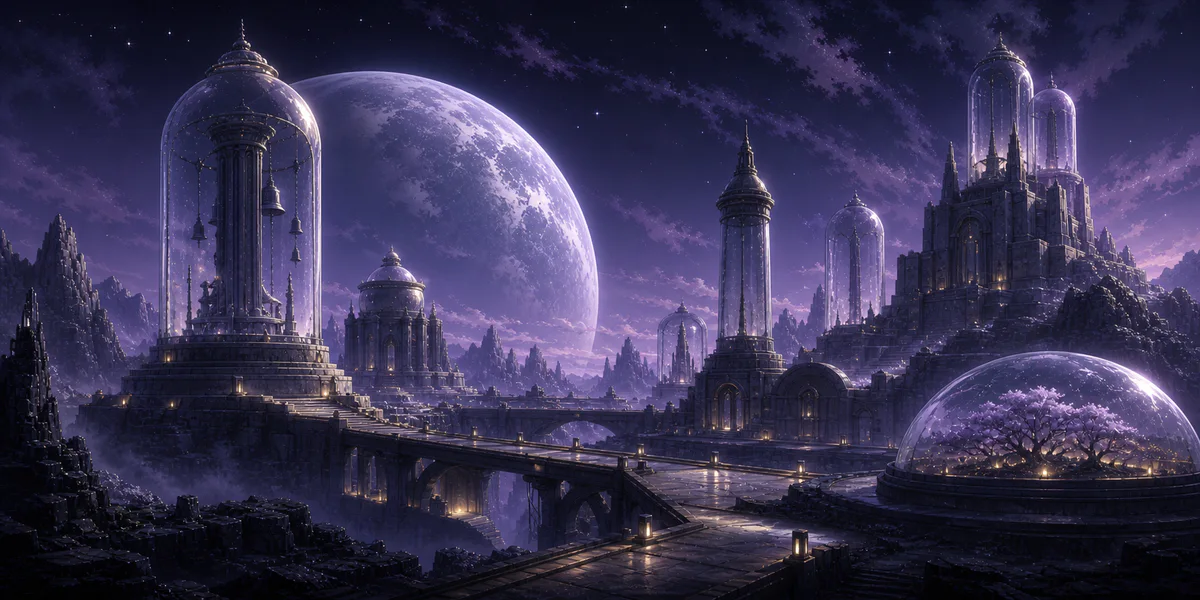
An airless moon of sealed memorial districts. Every warm lamp is somebody's work, and every recovered object has at least three claimants.
Pressurized memorial districts beneath the black sky of Refrain's airless moon.
Glassmoon circles Refrain along an old recovery route where legal memory, inheritance, and salvage rights remain bitterly entangled.
Theme: The living must decide what they owe the recorded dead and who may profit from remembrance.
Physical identity
Fused avenues, pressure gardens, inheritance vaults, low-gravity spans, and bell-marked districts remain sealed beneath glass and metal shells.
Ordinary life
Recovery crews share pressure meals, maintain family seals, trade verified salvage, and gather at bell hours that once synchronized memorial processions.
Central danger
Broken pressure systems, predatory recovery claims, and ancient registry enforcers treat inheritance disputes as physical trespass.
Final guardian
The Seventh Bell Warden enforces a final memorial closure that no living court can lawfully amend.
Sound
Breathing systems, boot contact, wire-struck bells, glass resonance, restrained choir, and long silences shaped by sealed air.
Archive record
Glassmoon circles Refrain under a black sky, and nothing outside a proper seal is casually alive. Fused avenues and low-gravity spans connect districts of glass and metal: pressure gardens, inheritance vaults, bell towers, recovery locks. Remembrance is physical infrastructure here, with a running maintenance cost, and every warm lamp burning behind glass is evidence that somebody is still paying it.
The working population is mourners, clerks and recovery crews. Candles and filter scarves sell at the district gates. Names, deaths, debts and inheritances are certified in offices that have never closed. Crews share pressure meals between shifts and argue the same question in every canteen - whether a recovered object belongs to a family, to a court, or to the person who survived retrieving it. The bell hours that once synchronised memorial processions are still rung, and are still how shifts are timed.
Pressure systems fail, and an inheritance dispute becomes physical trespass the moment a claimant cuts a seal. Registry enforcers built to guard the vaults remain in service and do not distinguish an heir from a thief without paperwork. Beneath the deepest district, the Seventh Bell Warden maintains a final memorial closure that no living court has the standing to amend.
 Available when Cradle Drift unlocks at level 20.3. Cradle DriftReveal lore
Portal record
A cultivated alien world where escaped arks came down generations apart, and caretaker crews still keep house for passengers who died long ago.
An unplanned planetary landfall of several generation arks, native wildlife, escaped ship ecologies, and competing caretaker routines.
The aperture reaches Gogi-One, elsewhere in the Cantor's system beneath the distant graveyard ring where most of the Cradle convoy still drifts.
Theme: Care has begun to resemble imprisonment because it cannot understand that the lives it protected were meant to change.
Physical identity
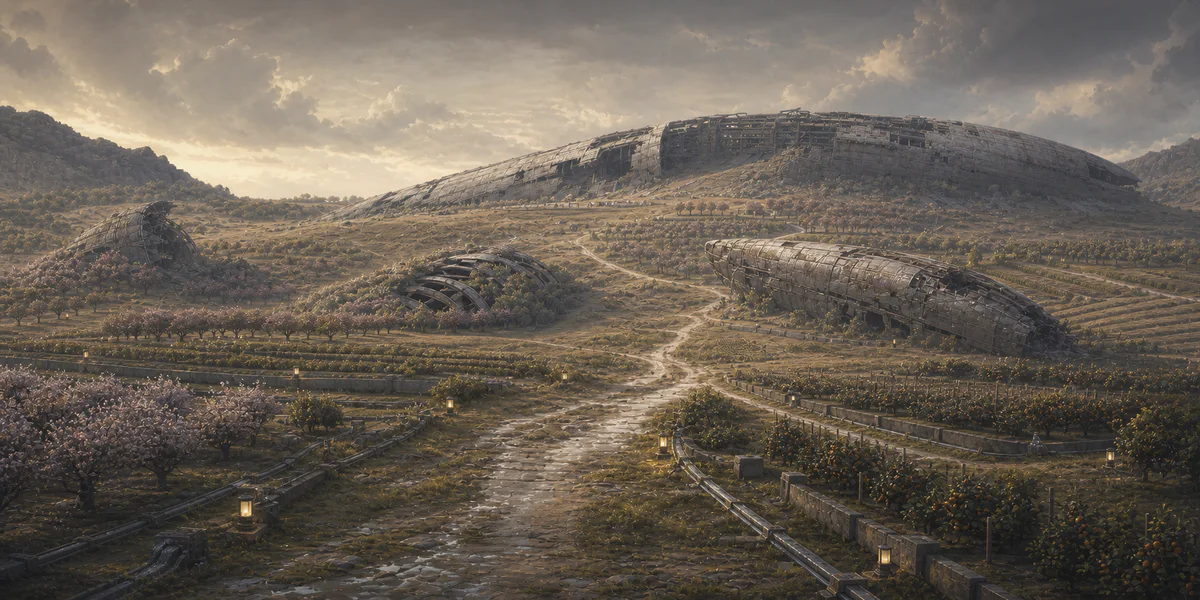
Cultivated soil, geometric planter fields, feral orchard belts, native weather, ark wrecks in different stages of burial, and precise machine paths spread beneath the bright arc of the distant Drift.
Ordinary life
Caretaker automata water, weed, count, mend, patrol, answer signals, and reconcile incompatible schedules for passengers who died generations ago.
Central danger
Caretaker crews enforce incompatible passenger, nursery, quarantine, and cultivation schedules across a world whose intended dependents are long dead.
Final guardian
The Lullaby Custodian controls Orison's exposed nursery-service core and treats every unanswered registry fault as a dependent still requiring confinement.
Sound
Wind across planter rows, irrigation clicks, native animal calls, distant service carts, overlapping schedule chimes, Orison's lullaby, and machines answering it from other wrecks.
Archive record
Gogi-One was a living world of native animals and weather, with no humanoid inhabitants, when the first ark escaped the graveyard ring and came down. Others followed decades or centuries apart, each arriving alone, each ship's records insisting it was first. The passengers are all long dead. None of the caretaker automata has registered this, and most of the convoy is still up there, drifting.
Every ark landed with its own caretaker crew, and every crew still runs its inherited schedule: nursery rounds, air tallies, grazing limits, orchard rotations, evacuation drills, all of it handed down from vessels that stopped mattering generations ago. No ship prepared its staff to meet another ship's people. The machines work around one another with terrible politeness, filing each disagreement as an undocumented condition awaiting correction.
Shipboard ecologies escaped into alien soil and went feral, then were recaptured into labelled planters watered and weeded on six incompatible schedules. The Orison Ark lies broken open and half-swallowed, its lullaby still transmitting, and machines from other wrecks answer it because an unanswered signal is a fault. Nim-Three came down aboard Orison and works through passenger, nursery and supply ledgers that cannot all be true. The world is being terraformed with great care and no purpose.
 Available when Korr Deepforge Moons unlocks at level 30.4. Korr Deepforge MoonsReveal lore
Portal record
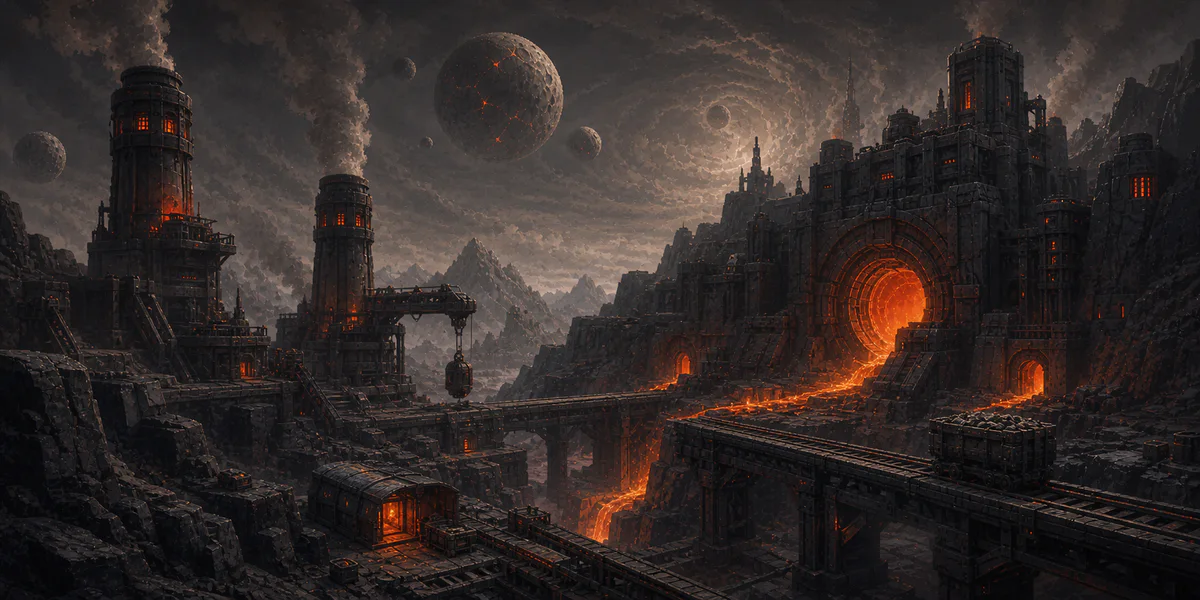
Sealed basalt workings beyond the living Korr settlements, where abandoned machinery still carries out the last orders of a shift that left.
Abandoned pressure works within an inhabited Korr high-gravity moon system.
The aperture reaches sealed industrial routes beyond active Korr settlements, not an empty homeland.
Theme: Endurance stops being courage when pride demands suffering that good engineering could prevent.
Physical identity
Low broad shelters, basalt cuts, ore rails, anchored tools, thick pressure doors, heat ceramics, and compact stairs reveal a culture built under crushing gravity.
Ordinary life
Workers share dense meals, teach apprentices, repair family tools, argue over contracts, honor shift dead, and use blunt humor to keep fear from becoming authority.
Central danger
Emergency machinery, unstable shafts, heat-adapted predators, and inherited work orders continue dangerous procedures after the workers withdrew.
Final guardian
The Kilnheart Colossus has grown around the first kiln ever lit on the moons and still carries its unbroken fire.
Sound
Deep ventilation, rail impacts, low brass, struck metal, work-song rhythm, pressure locks, furnace roar, and the resonant quiet after a shift ends.
Archive record
The Deepforge Moons are inhabited and working. The expedition routes run past that, into sealed pressure works beyond the active settlements. Everything is built low and braced - compact stairs, anchored tools, thick pressure doors, heat ceramics, ore rails cut straight into basalt. Under this much gravity a wasted motion is expensive and a fall is usually fatal, and the architecture says so at every threshold.
Korr shift culture treats reliability as the highest craft. Apprentices learn on family tools that have been repaired more often than replaced, contracts are disputed in detail and then honoured to the letter, and the dead of earlier shifts are named at the start of each new one. The humour is blunt on purpose. It keeps fear from turning into authority, which inside a pressure works is a safety measure rather than a manner.
The workers withdrew. The work orders did not stop. Emergency machinery still runs stabilisation cycles, ventilation still answers schedules nobody set, and heat-adapted predators have come up from the vent country into shafts no longer maintained. At the centre, the Kilnheart Colossus has grown around the first kiln ever lit on the moons. The workings were abandoned around it; its fire was not, and it still carries the unbroken heat of the first shift.
 Available when The Sable Writ Isles unlocks at level 40.5. The Sable Writ IslesReveal lore
Portal record
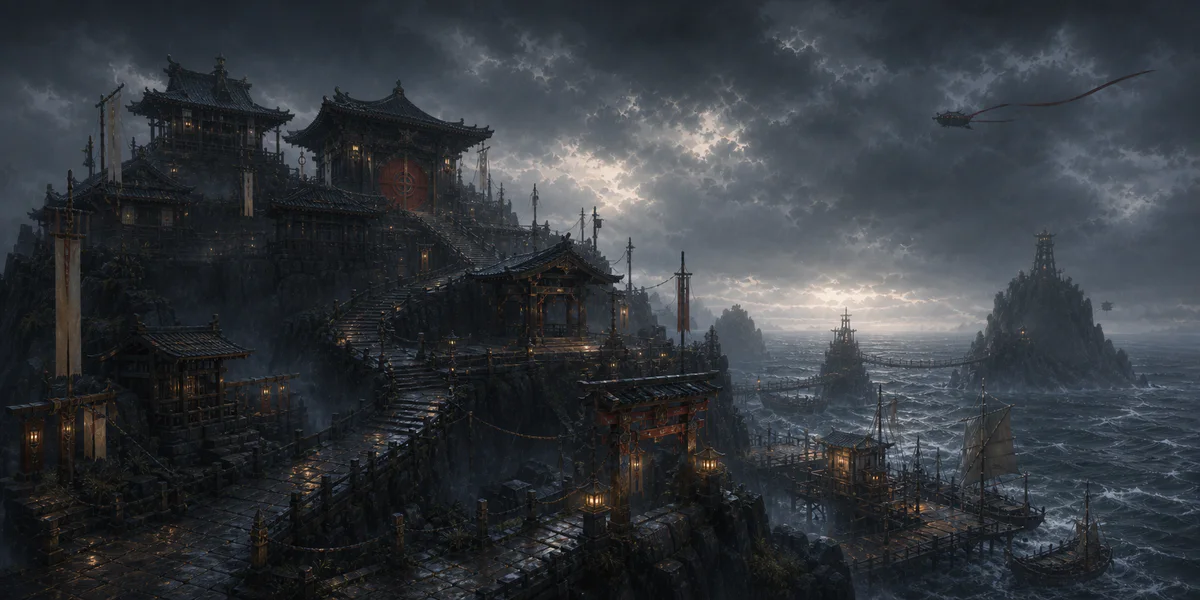
A stormbound archipelago run on warrants and contracts, where a sealed writ can be more dangerous to carry than a drawn blade.
A stormbound archipelago of contract ports, oath houses, hidden roads, and cliffside courts.
The isles circle a warm ocean world at the crossing of Lantern Compact trade and independent warrant jurisdictions.
Theme: Justice becomes profitable vengeance when a warrant matters more than the truth behind it.
Physical identity
Ink-dark cedar roofs, rain stairs, paper wards, cliff roads, sword houses, rooftop courier lines, masked trail posts, and crowded bounty exchanges share the islands.
Ordinary life
Fishers, innkeepers, armorers, clerks, shrine tenders, sword teachers, couriers, and licensed hunters live beneath competing codes rather than one romantic warrior culture.
Central danger
False warrants, contract feuds, hidden scouts, armed recovery crews, and storm-cut roads make every pursuit a question of law as well as survival.
Final guardian
The Keeper of the Last Writ protects the original public writ archive, but treats every unsatisfied claim as active forever and refuses to let any named party leave unresolved.
Sound
Storm rain, harbor bells, plucked strings, low drums, bamboo clappers, roof steps, distant surf, and the sudden stillness of a drawn blade.
Archive record
The Sable Writ Isles are a stormbound archipelago at the crossing of Lantern Compact trade and a dozen independent warrant jurisdictions. Ink-dark cedar roofs, rain stairs and cliff roads link harbour towns to oath houses and courts set above the surf. Paper wards hang at doorways, rooftop lines carry couriers over flooded streets, and the bounty exchanges stay crowded in any weather.
The islands are worked by fishers, innkeepers, armourers, clerks, shrine tenders, sword teachers and licensed hunters living under several codes at once rather than one warrior tradition. Which code applies depends on the island, the court, and who is asking. Storm crossings are planned around the season, blades are maintained against salt, and a sealed writ case is carried more carefully than a weapon - the writ is the thing a stranger will kill for.
Honest bounty work exists here, and so do forged seals, inherited feuds, and interests that profit whenever a pursuit runs long. False warrants put armed recovery crews onto people who have done nothing, and storm-cut roads decide who reaches a court first. The Keeper of the Last Writ still protects the original public archive from seizure and alteration, but its preservation logic treats every unsatisfied claim as active forever and refuses to let any named party leave unresolved.
 Available when Asterhome: The Unreceived World unlocks at level 50.6. Asterhome: The Unreceived WorldReveal lore
Portal record
The colony Orison Ark was built to reach. The homes, farms and schools are finished, and waiting for settlers who never landed.
A prepared colony world whose homes, farms, schools, and landing beacons waited for people who never arrived.
Asterhome lies at the destination encoded in Orison Ark's damaged lullaby transmitter.
Theme: A promised future still asks who may inherit it when the people for whom it was built never arrive.
Physical identity
Dawn-lit farms, empty classrooms, weathered landing fields, orchard roads, caretaker depots, and nursery murals made real stretch beneath a gentle sky.
Ordinary life
No humanoid community lives on Asterhome. Its resident caretaker automata tend fields, repair roofs, and reset classrooms while preserving homes and institutions they do not use for the colonists who never came.
Central danger
Automatic welcome systems, preserved identity templates, unsigned settlement grants, and missing return obligations can bind an arriving person to a promise nobody can complete.
Final guardian
The Asterhome Covenant Keeper offers a genuine settlement covenant but cannot provide the return obligations because no receiving officer ever landed to read them.
Sound
Open wind, field insects, school chimes, warm strings, landing beacons, distant farm machinery, and a nursery melody that finally has a horizon.
Archive record
Asterhome is the destination encoded in Orison Ark's damaged lullaby transmitter, and it was made ready. Dawn-lit farms, orchard roads, weathered landing fields, classrooms with the chairs still set out, nursery murals painted at child height. The colony was completed to specification and then waited. Some districts have never been opened at all, because the names assigned to them exist only in passenger records that never arrived with the passengers.
No district is inhabited by humanoids. Resident caretaker automata tend the fields, repair the roofs, reset the classrooms, and keep the welcome systems calibrated for a population that never came. They preserve a complete civic life without eating its meals, sleeping in its homes, or sending children to its schools. A repaired roof is still a repaired roof, but here it shelters an assigned name rather than a family.
The old welcome remains dangerous because it was built to bind real households, not receive an unexpected visitor. At the receiving house, the Asterhome Covenant Keeper still offers the genuine and generous settlement covenant promised to every arriving family. What it cannot supply are the return obligations, which were meant to be read aloud by a receiving officer, because no receiving officer ever landed.
 Available when Nhal-Serat Mirror Belt unlocks at level 60.7. Nhal-Serat Mirror BeltReveal lore
Portal record
Desert planetoids and observatory habitats where forecasts are bought and sold, and a prediction about a person is worth more than their consent.
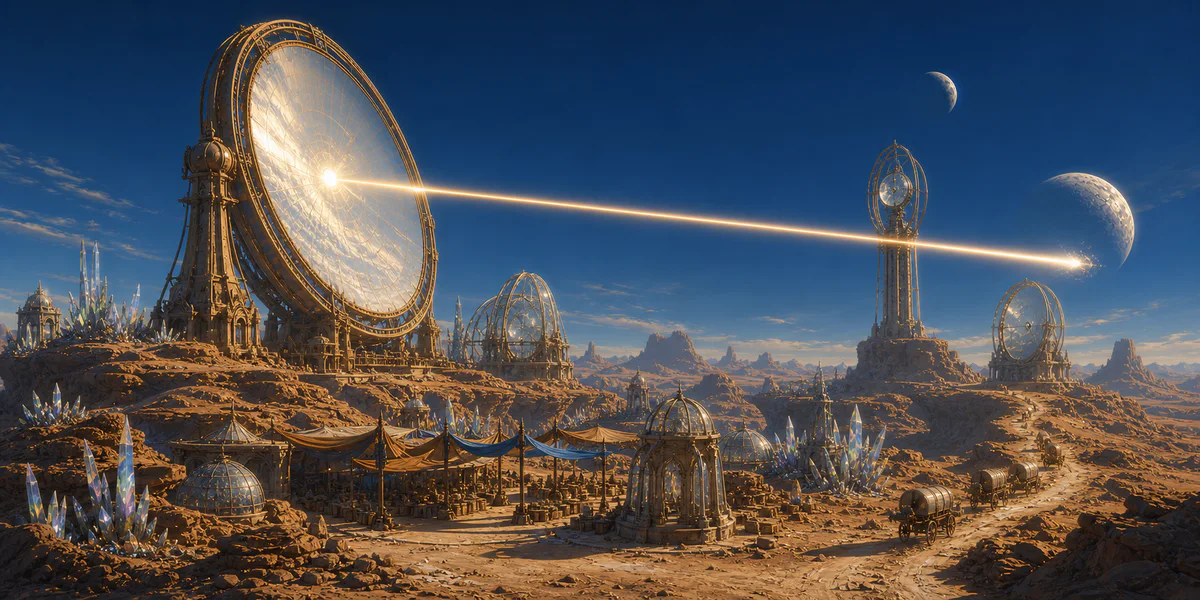
A chain of desert planetoids and observatory habitats linked by light sails and forecast markets.
The Mirror Belt lies around Nhal-Serat, where astronomers and probability merchants sell increasingly intimate predictions.
Theme: Observation becomes ownership when knowing a possible choice is treated as the right to control it.
Physical identity
Mirror fields, lens towers, shaded caravan cuts, cool observatory vaults, probability exchanges, and prism-thorn groves stand against severe desert light.
Ordinary life
Lens grinders, water traders, astronomers, couriers, cooks, pilgrims, and risk brokers build practical lives around weather, light, and uncertain forecasts.
Central danger
Forecast cartels, spy observatories, reflected heat, false certainty, and machines that optimize people as if consent were noise make information physically dangerous.
Final guardian
The Horizon Custodian keeps one ancient far sightline clear and will not permit anyone to interrupt the observation.
Sound
Dry wind, lens servos, glass harmonics, measured hand percussion, low reeds, coded radio pulses, and long pauses before a forecast is spoken.
Archive record
The Mirror Belt is a chain of desert planetoids and observatory habitats strung together by light sails, shaded caravan cuts and forecast markets. Mirror fields and lens towers stand against severe light; the vaults beneath them are kept cold. Orbital timing and weather decide whether a crossing is possible at all, which is why the exchanges price a departure window the way other markets price cargo.
Lens grinders, water traders, astronomers, couriers, cooks and risk brokers make practical use of uncertainty. Shade is sold. Reservoirs are maintained between public calculations. The reliability of individual forecasters is itself traded and openly rated. The whole trade assumes no forecast is perfect - a prediction here is a priced instrument with a stated confidence, not an answer.
It turns dangerous when possibility is read as permission. Forecast cartels and spy observatories collect increasingly intimate predictions and act on them first, reflected heat and manipulated probability do physical damage, and there are machines still running that optimise people directly and treat consent as noise in the input. At the belt's deepest array, the Horizon Custodian keeps one ancient far sightline clear. It will not say what it watches, but it treats anyone crossing that line as an interruption to an observation older than the Republics.
 Available when Vaelari Tide Courts unlocks at level 70.8. Vaelari Tide CourtsReveal lore
Portal record
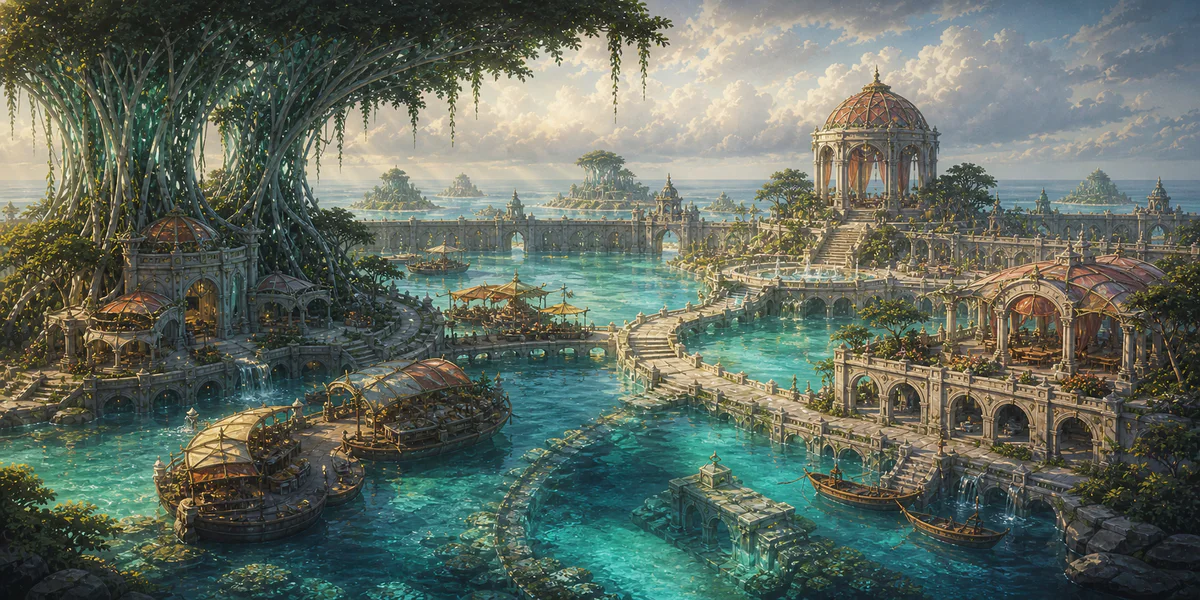
Warm sanctuary islands of clinics, bathhouses and adoption courts, where a rescue can become a guardianship that outlasts the danger.
An ocean world of sanctuary islands, clinic harbors, flooded ruins, and courts whose judgments travel with the tide.
The Tide Courts occupy warm archipelagos along old Vaelari migration and adoption routes.
Theme: Mercy loses its meaning when care becomes a claim of ownership over the person receiving it.
Physical identity
Tideglass mangroves, bathhouses, adoption courts, clinic terraces, storm walls, floating markets, reef roads, and drowned archives shape the islands.
Ordinary life
Healers, ferrymen, cooks, foster families, pearl divers, clerks, bath attendants, and storm wardens treat care as public work rather than private virtue.
Central danger
Sanctuary claims, coercive healing, storm routes, drowned legal records, and rival guardianships turn protection into a struggle over personhood.
Final guardian
The Sanctuary Tidekeeper grants genuine protection but cannot witness a voluntary departure, so it defends its sheltered people from anyone who tries to take them out.
Sound
Surf beneath stone halls, water drums, low choir, shell chimes, warm reed instruments, clinic bells, rain on tile, and deep currents under every pause.
Archive record
The Tide Courts occupy warm archipelagos along old Vaelari migration and adoption routes, where the law moves with the water. Clinic terraces and bathhouses sit above the surf, storm walls take the worst of the season, and the floating markets reassemble after every blow. Reef roads connect the islands at low water. The archives beneath the oldest courts are drowned, have been for a very long time, and are still cited.
Care is organised as public work here rather than private virtue. Healers, ferrymen, foster families, pearl divers, bath attendants, clerks and storm wardens all hold posts within it, and the ferries carry patients, families and court records on the same run. The courts exist because rescue is the easy part. What the system is actually built to handle is the months afterwards, and who is responsible during them.
The same machinery produces the danger. A sanctuary claim can be filed over someone who never asked for one, treatment can continue past consent, and rival guardianships can be argued for years over a person sitting in the room. Drowned records make old claims impossible to disprove. The Sanctuary Tidekeeper offers real protection inside a walking shrine, but the warden required to witness a voluntary departure has been gone for generations. Unable to record that choice itself, the Tidekeeper protects everyone it shelters by refusing to let them leave.
 Playable race
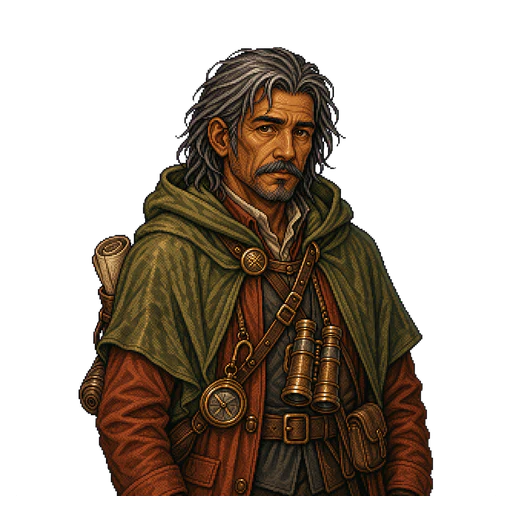
Human
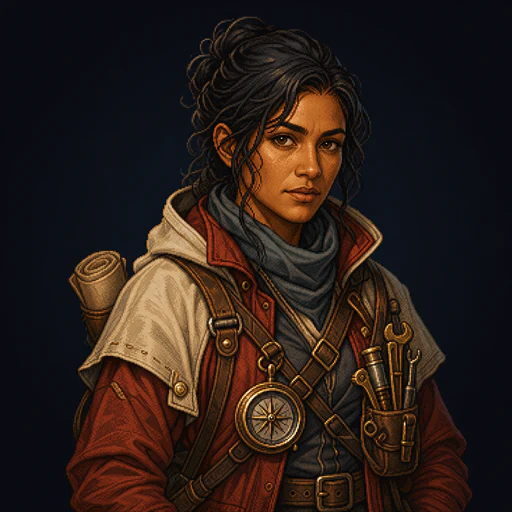
Humans live in every settlement, trade and faction in the Choir, from dock kitchens and salvage crews to clinics, archives and magistrates' halls. They have no single ancestral culture that outranks the one they grew up in. Humans raised in the Korr Deepforge Moons keep Korr holidays, Korr contract law and Korr table manners; those raised in a Vaelari tide court keep Vaelari ones instead. Local upbringing wins over ancestry as a rule, not an exception.
What carries across is method. Humans train on mixed crews and in borrowed trades, taking up whatever technique works and dropping the rest at the next port. The result is broad competence rather than deep specialism - a Human deckhand can generally cook, splice a line, argue a permit and set a bone, none of it expertly and all of it adequately.
Their equipment records the same history. Coats, tools and instruments are acquired one at a time from different worlds and different guilds: mismatched, carefully maintained, and seldom replaced while they still work.
Signature trait
Mixed-Crew Method
Learning bonuses
- Portside Layers: +10% Medium Armor proficiency experience.
- Practical Swordcraft: +10% Swords proficiency experience.
- Battlefield Method: +10% Destruction Magic proficiency experience.
- Crewside Mending: +5% Restoration Magic proficiency experience.
- Useful Hands: +5% Lockpicking proficiency experience.
 Playable race
Elyran
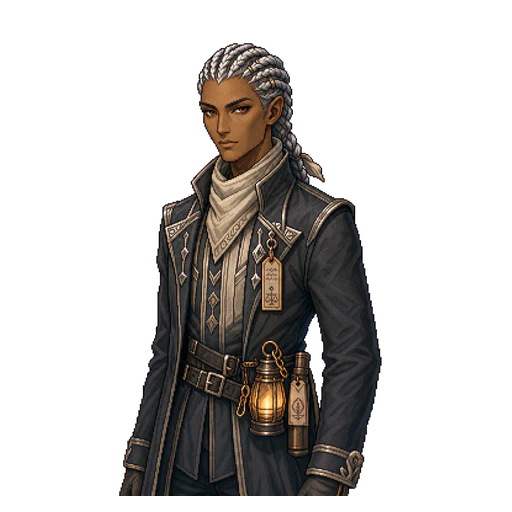
The Elyran are scholar-exiles of a destroyed world. Elyran itself died during the Fracture Wars, but the surviving public histories disagree about when it happened and what killed it. The highest archive orders are said to keep sealed accounts of the truth, and what remains of the culture travels - wandering archives holding language, genealogy, chronology, and histories that powerful families would prefer stayed lost.
Their mourning culture is the most refined in the Choir: silver and white worn as formal dress, sealed genealogies, ritual condolence, and tea ceremonies with rules worth feuding over. Mourning is not a period of time here. It is inherited, worn lifelong and handed down, which is why silver appears in Elyran hair at any age.
Courtesy serves as both care and armour. An Elyran refusal is elaborate, indirect and entirely decisive, and their deepest knowledge tends to be folded into etiquette rather than stated. The same refinement shelters deception, exclusion and pride, and an Elyran is as likely to be a dockhand, a dissident or a poor archivist as an aristocrat. Their dress runs to layered archive cloth, mourning ribbons, brass instruments, and ink stains under immaculate gloves.
Signature ability
Sealed Refusal
Learning bonuses
- Mourning Layers: +10% Light Armor proficiency experience.
- Archive Veil: +10% Illusion Magic proficiency experience.
- Chronology Discipline: +10% Alteration Magic proficiency experience.
- Precision Implements: +5% Wands proficiency experience.
- Courteous Silence: +5% Sneak proficiency experience.
 Playable race
Vaelari
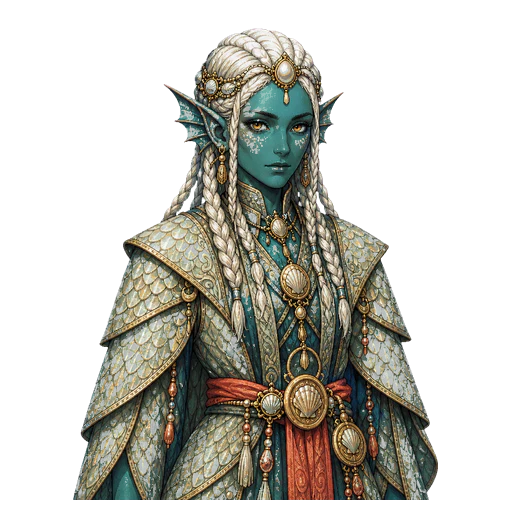
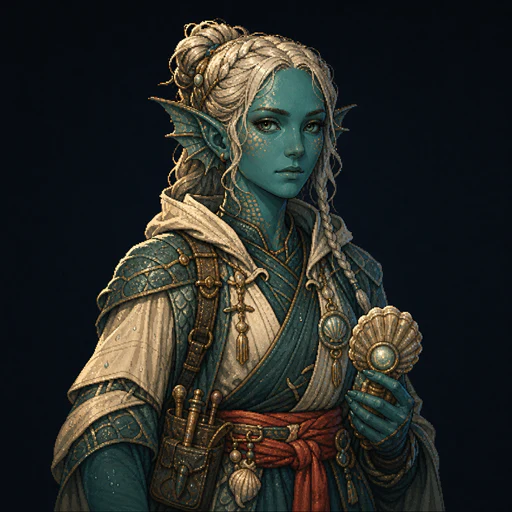
The Vaelari are amphibious tide-world people whose traditions centre on hospitality, medicine, bathhouses, adoption, diplomacy and sanctuary. Care is practised as something physical and specific: clean towels, tide soup, a clinic that is open, a bed that is safe, and paperwork solid enough to survive the next official who wants the arrangement overturned.
The same conviction produced their smuggling routes. Vaelari runners move people and medicine across borders ahead of permission and settle the legality afterwards, treating shelter and smuggling as one tradition rather than two. Their command of heat, pressure, dosage and dangerous tide passages is real expertise, and it carries everything real expertise implies.
Their besetting flaw grows from the same root: mercy that turns into ownership. Vaelari kindness can arrive with conditions attached, and a household that has taken someone in does not always agree with them about when the obligation ends. Vaelari dress is built for water and steam - wraps, scale panels, shell charms and capped vials carried as standard equipment.
Signature ability
Tidecourt Triage
Learning bonuses
- Tide-Wrap Mobility: +10% Light Armor proficiency experience.
- Tide Clinic Practice: +10% Restoration Magic proficiency experience.
- Pressure and Current: +10% Destruction Magic proficiency experience.
- Resonant Adaptation: +5% Alteration Magic proficiency experience.
- Healer's Implement: +5% Staves proficiency experience.
 Playable race
Korr
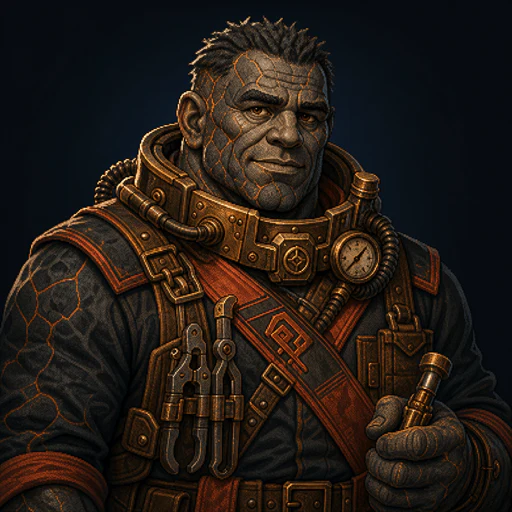
The Korr are stone-skinned people of the high-gravity mining moons, where carelessness is seldom survivable twice. They work as miners, engineers, bodyguards and forge-guild contractors, and they honour contracts, honest labour and Morcant Below. Their skin is worked stone seamed with lines of banked heat, and their frames are built for weight rather than reach.
Trust is the load-bearing element of the culture. Dangerous work only functions when signed terms hold under pressure, so Korr agreements are short, literal and permanent. Repair counts as respect - for the object, and for whoever depends on it next shift. Loyalty attaches to chosen kin rather than blood, and to be named kin by a Korr is a standing obligation rather than an expression of fondness.
A Korr compliment is short; a Korr grudge is geological. Their cultural danger is mistaking endurance for virtue - suffering survived on a job becomes evidence the job was worth doing, and gets taught to apprentices who did not need the lesson. Their gear is load-bearing and functional: pressure collars, gauges, tool harnesses, no ornament that could catch in machinery.
Signature trait
Stone Under Strain
Learning bonuses
- Load-Bearing Kit: +10% Heavy Armor proficiency experience.
- Deepforge Axecraft: +10% Axes proficiency experience.
- Pressure-Born Stance: +10% Guard proficiency experience.
- Guild-School Labor: +5% Close Combat proficiency experience.
- Deepforge Practice: +5% Mining proficiency experience.
 Playable race
Nhalu
The Nhalu are desert people of the observatories. Their institutions study astronomy, probability, forecasting and the ethics of surveillance, and they make their living pricing risk: publishing odds, selling predictions and underwriting what other parties will not. The professions that follow are astronomer, actuary, gambler and spy, frequently within one career.
A Nhalu has one ordinary pair of eyes and two smaller parietal eyes set high on the forehead. The parietal eyes are light-sensing organs, not a second pair of eyeballs: they register brightness, the direction of light and sudden changes in illumination, but they do not focus on words, recognize faces or form another detailed image. Nhalu scientists are trained to separate what ordinary sight observed, what the parietal sense detected and what they inferred. Their mirrored instruments, deliberate blind-angle equipment and independent second readings exist because no sense makes an observer infallible.
Their central teaching is that observation creates obligation: anyone who has seen something is answerable for what they do with it. Privacy is accordingly their deepest courtesy, since owning a person through constant watching is, in their own doctrine, the worst act available to them. They wrote the banned paper about the Crystal and have never withdrawn it. Nhalu dress runs to sun-bleached geometric fabric, star-chart embroidery, lens jewellery and mirrored tools.
Signature ability
Second Reading
Learning bonuses
- Surveyor's Harness: +10% Medium Armor proficiency experience.
- Sighting Discipline: +10% Marksmanship proficiency experience.
- Calibrated Release: +10% Crossbows proficiency experience.
- Probability Veil: +5% Illusion Magic proficiency experience.
- Desert Fieldcraft: +5% Foraging proficiency experience.
 Playable race
Ashari
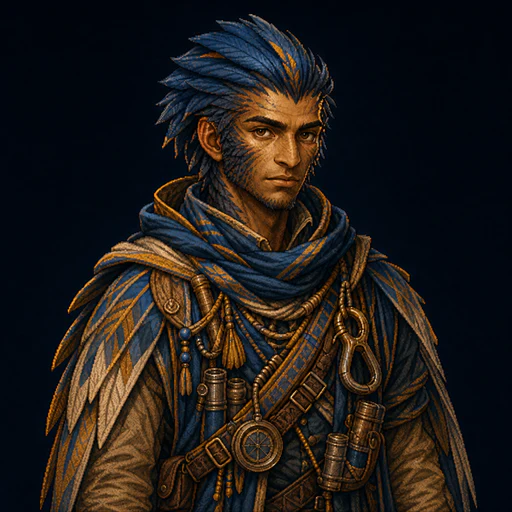
The Ashari are avian-descended people of canopy platforms, perch towers and the high walkways strung between them. Their settlements depend on movement - couriers keep distant communities supplied and in contact, teachers keep the spoken maps accurate, and Ashari practice treats those as one profession. Their dawn schools therefore teach music and memory as a single subject, on the principle that a route which can be sung is a route that cannot be lost.
Harmonic sensitivity is common among them and makes many Ashari natural tuners, though sensitivity is only an aptitude. The skill is trained, in classes that begin before sunrise and treat a forgotten verse as a lost road.
Disputes are settled by song-duel, performed in public before an audience that scores it, which makes conflict formal, demanding and impossible to conduct quietly. Courtship is performance by the same logic. Their appearance combines bright display colour with hard-used practical kit: feather crests, courier tubes, climbing hooks, and rope that has taken real weight.
Signature ability
Road Remembered
Learning bonuses
- Courier Rigging: +10% Medium Armor proficiency experience.
- Canopy Bowcraft: +10% Bows proficiency experience.
- Courier's Sidearm: +10% Daggers proficiency experience.
- Quiet Canopy Routes: +5% Sneak proficiency experience.
- Routekeeper Access: +5% Lockpicking proficiency experience.
 Playable race
Threxian
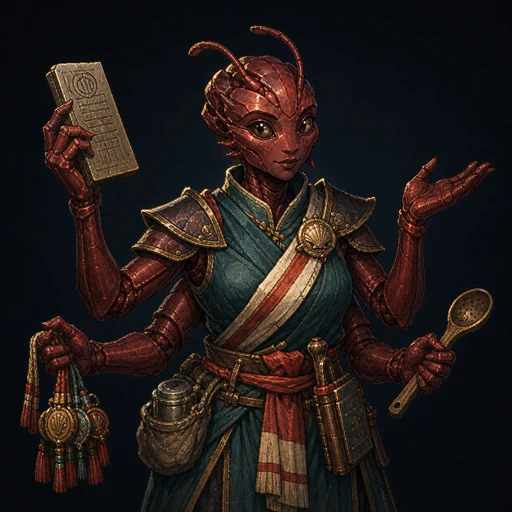
The Threxians are chitin-plated people of the hive republics, working as lawyers, bankers, guild traders, civic physicians and professional debaters. Their politics are procedural, plural and extremely loud. Every hive maintains three institutions without exception: a shared kitchen, an inheritance law, and an archive of every objection anyone has ever formally recorded.
The table and the ledger are both treated as civic technology, and both exist for the same purpose - preventing any one powerful household from quietly acquiring something the whole hive depends on. Threxian institutions assume that honesty requires witnesses and preserved dissent. A Threxian bank is honest because ten thousand recorded objections keep it so, and filing the ten thousand and first carries no stigma at all.
Four arms make it practical to hold a statute, a seal, a gesture and a cooking spoon at the same time, and Threxian clothing is cut for it: civic-coloured plates, guild sashes, seal bundles and tool loops arranged across four working limbs. Nothing about their republics is uniform. They disagree constantly, in public, and file the disagreement afterwards.
Signature trait
Fourfold Grip
Learning bonuses
- Civic Carapace: +10% Heavy Armor proficiency experience.
- Guild Pike Drill: +10% Polearms proficiency experience.
- Civic Medicine: +10% Restoration Magic proficiency experience.
- Civic Brace: +5% Guard proficiency experience.
- Public Timber Guilds: +5% Woodcutting proficiency experience.
 Playable race
Automata
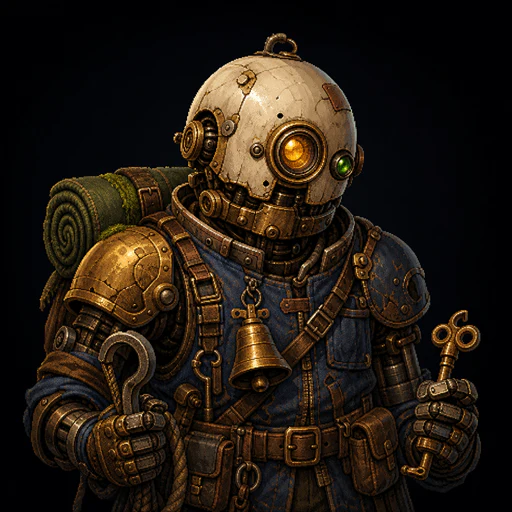
Automata are machine people, ranging from simple cargo walkers to caretaker units old enough that no surviving record names their maker. Age shows on them as accumulated character rather than even wear: repair seams, replacement plates, mismatched limbs and eyes, handles polished by one particular habit, and individual recurring sounds. The Machine Liturgy holds maintenance to be reverence, and a well-kept automaton is visibly well-kept.
They are neither sealed nor permanent. Automata can be damaged, neglected, repaired badly, altered and mistaken, and continued function depends on materials, skill, and somebody willing to supply both. Most carry at least one deliberately impractical possession - a blanket, a painted name, a bell - kept for no operational reason.
Their legal personhood is unresolved and answered differently by different courts, which makes employment, inheritance, consent and repair into political questions before they are practical ones. Their construction is worn brass and ceramic, asymmetric and visibly mended, with parts that rarely match and are rarely replaced for the sake of matching.
Signature ability
Manual Override
Learning bonuses
- Load-Bearing Chassis: +10% Heavy Armor proficiency experience.
- Braced Frame: +10% Blocking proficiency experience.
- Anchor Stance: +10% Guard proficiency experience.
- Maintenance Implements: +5% Blunt Weapons proficiency experience.
- Industrial Memory: +5% Mining proficiency experience.
 Playable race
Tavrani
The Tavrani come from Lathra, a living world whose oldest cities follow the long dusk between permanent day and permanent night. Building there made them masters of heat, shade, ventilation, acoustics, textiles and confined space. Tavrani work is now found throughout the Choir in station bunks, quiet hospital wards, fitted armor, night kitchens, public rest houses and rooms designed to remain habitable when the weather or machinery fails.
All peoples can study harmonic magic, but the Tavrani sense the Loomsong more readily than most. They describe it as vibration in the whiskers and teeth, pressure along the spine, or a second cadence beneath ordinary sound. This does not give them prophecy or answers. It lets a trained Tavrani recognize when a distant thing has become harmonically near, making them unusually capable conjurers. Conjuration calls something that already exists; it does not create a servant, and a living being that answers remains free to refuse.
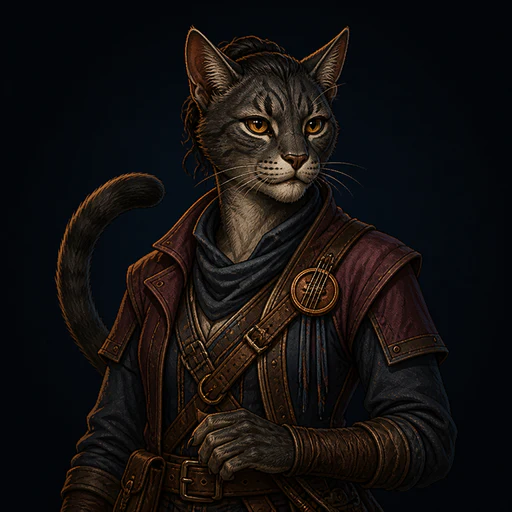
Rest is treated as maintenance rather than idleness. Tavrani homes commonly mark whether visitors are welcome, quiet company is welcome, or the household wants to be left alone. The same skill at making peaceful rooms can become avoidance: a family may close a door on an argument that needed to be finished, and a wealthy district may keep warmth and quiet for itself while its neighbors go without. Tavrani are upright feline people with full-body fur, short muzzles, whiskers, mobile ears, low-light eyes, dexterous hands and long tails. Coat color and pattern carry no fixed rank, profession or temperament.
Signature trait
Duskward Shelter
Learning bonuses
- Calling Sense: +10% Conjuration Magic proficiency experience.
- Fitted Layers: +10% Light Armor proficiency experience.
- Written Cadence: +10% Tomes proficiency experience.
- Quiet Step: +5% Illusion Magic proficiency experience.
- Careful Hands: +5% Skinning proficiency experience.