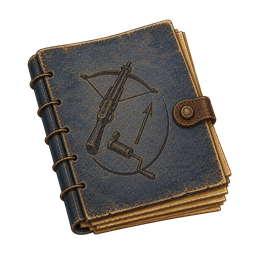
An armorer's guide to crossbow prods, strings, locks, bolts, spanning methods, loading discipline, range, weather, and the dangers of carrying a weapon under tension.
A crossbow stores the work of loading until the wielder releases it.
This allows a heavy draw to be held without the archer's muscles remaining under the same strain. The weapon usually strikes harder and reaches farther than a comparable bow. It is also heavier, slower to load, and dependent upon a lock that must hold until the exact moment it is asked to let go.
Respect the lock.
The working parts
The prod bends and stores energy. The string transfers that energy. The stock gives the weapon a stable body. The rail guides the bolt. The catch holds the drawn string. The trigger releases it. A stirrup, lever, crank, belt hook, or other spanning device helps draw the string into place.
Inspect every part before loading.
Look for cracks, twists, lifted layers, corrosion, loose fasteners, damaged string, and dirt inside the lock. Move the trigger only while the weapon is unloaded and pointed safely. Confirm that the safety device moves and holds, but never trust a safety enough to point a loaded crossbow at something that should not be struck.
The catch bears the full force of the drawn weapon. A worn edge may release early. A catch packed with grit may fail to seat. A trigger polished carelessly may become too easy to move.
Spanning the weapon
Use the method for which the crossbow was built.
Place the weapon securely. Keep hands and clothing away from the string path. Draw both sides evenly so the string seats at the center. An uneven draw sends the bolt poorly and places unnecessary stress on the prod.
Simple hunting crossbows may be drawn by hand or belt hook. Heavier patterns require levers, cranks, or built-in mechanisms. These devices reduce required strength but add time and more parts that can fail.
Do not force a crank after the string has seated. Do not shorten the loading cycle by leaving the spanning device attached unless the design requires it. A loose lever or crank becomes moving metal beside the face when the shot releases.
Under high gravity, lifting and holding the weapon takes more effort even when the crank bears most of the draw. Under low gravity, the crossbow's mass still resists rapid movement. Brace the body and use the same careful sequence.
Bolts
Crossbow bolts are shorter and often heavier than arrows. They must fit the rail, string, lock, and draw strength of the weapon using them.
Check the shaft, point, rear seat, and any fins or fletching. A bolt that sits too high may not receive the string cleanly. One that is too short can fall into a dangerous position. One too light may fail to carry away enough energy and damage the crossbow much like releasing a bow without an arrow.
Different points serve hunting, practice, hard targets, rope work, or other specialized tasks. No point defeats every material. A bolt capable of cracking one kind of protection may shatter, glance away, or bury itself uselessly in another.
Store bolts in a fitted case. Bellwire, briarbolt, cradlewire, pressure-steel, nightiron, welcome-latch, lenssilver, and stormchannel cases keep local ammunition organized and protected. Inspect any bolt recovered after impact before using it again.
Loading and firing
Keep the crossbow pointed toward the safe part of the range throughout loading. Span it. Confirm the string is centered and held. Engage the safety if the mechanism has one. Place the bolt correctly. Only then raise the weapon toward the target.
Keep fingers below the string path. A crossbow string crosses the stock with enough force to break or remove what rises into its way.
Set the stock firmly. Aim without holding breath so long that vision and judgment begin to fail. Release the trigger smoothly. Remain on the target long enough to see the bolt's path and the result.
After firing, decide whether there is time and space to load again. A crossbow is most vulnerable during spanning. Step behind cover or let another party member hold the approach. Do not stare at the mechanism while danger closes from the front.
Range and use
The crossbow suits guards, hunters, expedition parties, and fighters who need a strong first shot without holding a bow at full draw. The mechanical release also makes the same draw available to people whose bodies could not repeatedly draw an equivalent bow.
It does not remove the need for skill. Range judgment, target movement, wind, trigger control, safe loading, maintenance, and the decision to fire remain with the wielder.
Crossbows work well from prepared positions where loading can occur behind cover. They are awkward when climbing, wading, crawling, or moving through dense growth. The stock, prod, string, and spanning gear occupy more space than the shape first suggests.
Never carry a crossbow loaded for convenience through a camp, ferry, market, or party formation. A drawn mechanism under travel shock is not patient. Load when the shot may be needed and release it safely when the need passes.
Crossbows of the eight expeditions
Greenveil uses Vine-Latched Crossbows. Glassmoon has the Census Crossbow, a name from its older institutions rather than a statement about the target. Gogi-One carries Hushline patterns. Deepforge builds Pressure-Latch Crossbows. The Sable Writ Isles use Storm-Latch mechanisms. Asterhome has Choirstone-Latch Crossbows. The Mirror Belt produces Lensrail Crossbows. The Tide Courts use Stormchannel Crossbows.
These patterns adapt locks, stocks, prods, rails, and protective finishes to local materials. A mechanism designed for dry mineral dust may seize in salt spray. A string suited to wet heat may change under Glassmoon's controlled cold. Maintain the weapon for the world where it is used, not only the world where it was made.
Choose a crossbow when a strong, deliberate ranged shot justifies extra weight and a slower loading cycle. Learn the mechanism well enough to recognize a changed sound, uneven draw, or damaged catch before the weapon explains the fault by firing.