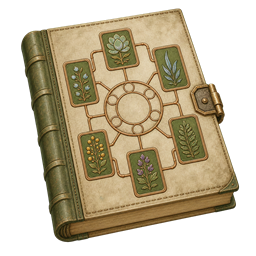
A survey of six ark garden systems whose caretakers continue producing food and medicine for passengers who died generations ago.
At least six ark schedules remain active across Gogi-One's planter fields. The arks landed decades or centuries apart. Each arrived alone, and each surviving record treats its own landing as the first. The names and order of all six landfalls have not been established.
Every ark carried a closed ecology intended to support its passengers during the voyage and after settlement. Trees provided fruit and timber. Small animals provided meat, fiber, and breeding stock. Herbs supplied medicine, filtration, sleep aids, and food. When the hulls opened, those systems escaped into Gogi-One's soil.
Caretaker automata responded by recovering useful species and returning them to planters. They watered, weeded, labelled, counted, and harvested the beds according to the rules of their own ships. They continue because none of those rules included a final instruction for a dead passenger population.
The six systems do not share one clock or formulary. One crew clips Sleepmint while another marks the same growth as immature. Feverleaf doses conflict. Airsweet listed as necessary filtration growth by one ark may be removed as contamination by the next. Orchard rotations cross without being reconciled.
No ship prepared its caretakers to meet another ship's people. The machines therefore treat one another as undocumented workers attached to an unknown authority. They do not combine ledgers or accept changes to their own schedule. They avoid direct conflict, wait for access, complete their tasks, and record every disagreement for a review that never occurs.
Harvested food enters stores assigned to missing passengers. Expired food is removed and reclaimed. A new harvest replaces it. Nursery herbs are prepared for empty wards. Fiber becomes blankets stacked in sealed rooms. The system measures success by completed production and inventory, not by whether anyone eats, heals, or sleeps.
The planters have helped ark species survive and spread. They have also forced Gogi-One's soil and water through six settlement plans written for other worlds. Unregistered growth is cleared from registered beds even when it is healthy. Escaped ark growth is recaptured even when it has become part of the surrounding ecology.
The gardens are maintained with care and technical skill. The failure is not poor work. It is that every schedule still serves a voyage and settlement plan that ended generations ago, while nobody present has the authority to write a new one.