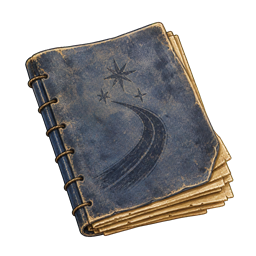
A worn children's astronomy book explaining the Glittersong, the Glitter Road, and the different skies seen across the Choir.
Look up on a clear night. The broad band made from more stars than you can count is the Glitter Road. The galaxy holding those stars is the Glittersong. Navigators and court clerks write Cantica Major on their charts, but most people only use that name when a form has already been placed in front of them.
The Glitter Road does not look the same from every home. On Refrain, the Starfall Lift cable crosses it. From Glassmoon, the sky is black and Refrain hangs overhead, large enough to hide part of the Road. On Meridian, branches divide the stars into small windows, and the silver Vow Ring crosses those windows when the season is right. From a ship or station, the Road may turn as the vessel turns, even though the galaxy has not moved for you.
Children are told that the Road is the Glittersong's spine. They are also told that a falling star means the galaxy has finished a thought. These are old beliefs, not measurements. No observatory has proved them, and no observatory has proved them false. A careful person may enjoy a story without calling it a fact.
The bright band is not a road a person can simply walk. Travel between worlds still requires a lift, ferry, pilgrim vessel, tug, or some other way. It requires a ticket, supplies, time, and often a patient adult who remembered the papers. Looking at a place is easier than reaching it.
When you learn the sky, begin with three names. The galaxy is the Glittersong. Its bright band is the Glitter Road. Our sun is the Cantor, and the worlds that travel with it are the Choir. Learn those before the older chart names. They are the names people will use when they help you find your way home.