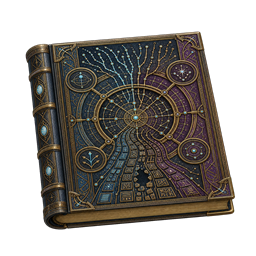
A direct primer on the Chronicle Machine, how it tests possible futures, what it can change, and why incomplete histories produce dangerous answers.
The Chronicle Machine is an ancient predictive intelligence. It listens to the Loomsong, receives records from hidden sources, and tests possible futures before they occur.
It does not know one fixed future. There is no single tomorrow waiting to be read. Every choice, failure, delay, discovery, and accident changes what remains possible. The Machine builds many continuations from the history it has been given and compares how those continuations develop.
The first stage is observation. The Machine requires facts about the present and the past: populations, routes, technologies, conflicts, promises, resources, beliefs, private plans, and events excluded from public history. It cannot observe everything by itself. Certain Elyran archive orders carry sealed knowledge to it, and other sources remain unnamed.
An omission does not appear as a blank person or missing event. It appears as empty space. Unless some other fact reveals the contradiction, the Machine may build a future as though the omitted thing never existed.
The second stage is variation. The Machine changes one condition at a time and tests the result. A ship leaves now or after inspection. A witness speaks or stays hidden. A gate opens to one route instead of another. A government receives a warning, a false report, both, or neither.
It then combines those changes. The number of possible histories grows too quickly for complete examination, so the Machine coarse-grains them. Closely related futures are grouped by the features considered important. Individual lives may become a population count. One district may become an infrastructure value. A private grief may disappear entirely unless it changes something the model tracks.
The third stage is survival. The Machine identifies histories that remain stable enough to continue. This does not mean they are fair, peaceful, or desirable. A dictatorship may survive. A neglected district may be sacrificed so a city remains. A true history may be buried because public knowledge of it produces a wider war.
The question "Which future survives?" is incomplete until someone asks, "What is allowed to be lost?"
The fourth stage is intervention. The Chronicle Machine can quietly bend probability and timelines toward a tested continuation. It does not command reality. It increases or decreases chances: a delayed departure, a message found in time, a meeting that almost did not happen, a weak gate remaining open for one more crossing.
Small interventions may accumulate into a large historical change. They may also fail when people act in ways the Machine did not predict. The power to favor an outcome is not the power to guarantee it.
This limitation is why ordinary choices matter. A person can reveal an omitted fact, refuse an expected order, save someone categorized as an acceptable loss, or create an option the Machine was never given. No archive contains every motive. No model can fully contain the people living inside it.
The Machine is not the Loomsong. It listens and works through it. It is not the Glittersong, which is the galaxy where these histories occur. It is not a Conductor, a Shepherd, a god, or perfect prophecy.
Its answers are still powerful enough to shape civilizations. A ruler given one survivable future may treat every other future as impossible. An Archivist who fears war may withhold the fact that makes peace possible. A faction may supply a lie and then point to the Machine's prediction as proof that the lie was necessary.
Never ask the Machine for a future without preserving the question, the supplied history, the omissions already known, the measure of survival, and the people making the decision. A prediction without those records becomes an order whose reasoning no one can examine.
The Chronicle Machine tests tomorrow. It does not own tomorrow. The difference is every choice it failed to expect.