A court investigator's account of the walking archive that carries the last writ it still considers current.
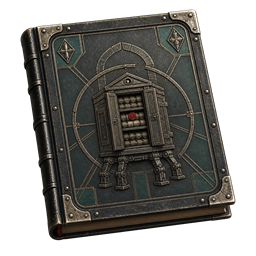
The Keeper of the Last Writ guards the original public writ archive. Its body is a large iron cabinet carried on mechanical legs. Shelves of rolled documents fill the inside, and a red seal is fixed above its doors.
Most of the documents it carries have expired. The Keeper stores them but does not present them for enforcement. One writ remains current according to its records. When somebody approaches, the Keeper opens its cabinet and displays that document.
Nobody who survived the encounter has read the full text. Rain obscures it at a distance, the Keeper does not allow a close inspection, and its enforcement begins almost immediately. A copied title, complete list of names, issuing court, and expiry have never been recovered. Any statement about the writ's contents remains a theory.
Two explanations are common. The first says the writ is a final order that still binds every person and court on the isles. The second says it is the legal instrument that dissolved the original courts, and the Keeper is enforcing an authority that the document itself ended. The Keeper has not confirmed either explanation.
During an encounter, the Keeper places an unexpired claim on one target. It then opens its archive doors and sweeps the surrounding area in measured sections. The space nearest the cabinet remains clear during the sweep, but reaching it requires crossing the Keeper's other attacks.
When heavily damaged, the Keeper calls Stormwrit Kites as required witnesses. Near the end of the fight, it begins a last appeal: two warned enforcement lanes cross at the current target while the Keeper acts more quickly. These procedures show that it still treats the encounter as a legal process. They do not show that the process is valid.
The Keeper cannot close an unsatisfied claim by deciding that too much time has passed. Its record recognizes no final expiry for the writ it displays. Named parties cannot answer, witnesses are missing, and the original court may no longer exist, but none of those facts completes the procedure it was built to follow.
Destroying the Keeper would stop its enforcement. It would not explain the writ, settle the claim, or prove that the document was invalid. Reading the last writ may answer those questions. Until somebody can do that, the Keeper remains a working archive enforcing a case nobody understands.