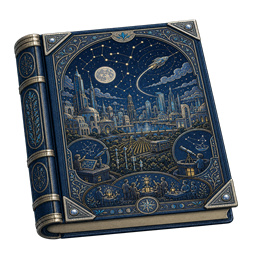
A memorial collection of Elyran's last surviving sky records, preserving the world as a place where people lived instead of reducing it to the moment of its death.
The Elyran Last Orbitarium does not show the destruction of Elyran.
There are surviving records from the Fracture Wars that claim to show that event. They disagree about the date, the sequence, and the forces responsible. Some may show different stages of the same disaster. Some may have been altered. The Orbitarium preserves them elsewhere, with their seals and contradictions intact.
This chamber shows the skies people recorded while a world still stood beneath them.
The first display comes from a public school. Its roof instrument measured cloud height, wind, and the brightness of the stars above the city. The final complete record begins in afternoon rain. Students had left notes in the observation log: one complained that clouds had spoiled a lesson, one had drawn a transit craft with far too many engines, and one had carefully corrected the names of two stars.
When darkness came, the clouds broke. Wet white stone reflected the lights of the city. Dark-glass towers moved across the instrument's view as the roof turned with the planet. The stars appeared at the expected times. Nothing in the record marks the evening as historic.
The second display was assembled from an agricultural weather station. Its keepers were more interested in rain than astronomy, so the record includes irrigation warnings, soil temperatures, and an argument over whether the next planting should be delayed. Workers crossed beneath the instrument carrying lamps. A freight vehicle stopped in the road while someone repaired its wheel.
Near midnight, a group entered the field and remained there for almost an hour. Later survivor testimony identifies them as two families meeting before one member departed for military service. The instrument did not record their words. It recorded their body heat, the lamps they set on the ground, and the open sky above them.
The third display comes from a private roof telescope. Its owner maintained no official archive. She recorded variable stars, passing ships, and the changing color of the upper atmosphere. Her observations were found decades later in a family collection carried away from Elyran before the war ended.
Several entries are written by her young son. He measured nothing correctly. He mistook a ferry for a comet, counted the same star twice, and insisted that one constellation resembled a hand holding a bowl. His mother corrected his numbers but left the drawings untouched.
The last page contains a planned observation for the following week. No result was entered. The empty space proves only that the record ended. It does not prove when the family left, whether they survived, or what happened on the night the page was meant to be filled.
The fourth display was recorded from an archive vessel in orbit. Elyran turns below it, whole and bright enough for the vessel's cameras to distinguish mountain snow, coastal weather, and the lights of inhabited regions. Navigation traffic crosses the view. Defense stations are active farther out.
One public chronology places this recording before the world's final destruction. Another places it after the first event that it calls Elyran's death. The vessel's clock supports both interpretations depending on which surviving calendar correction is applied. The Orbitarium does not choose between them.
The record ends when the vessel turns away to receive evacuees. The final image is not an explosion. It is the curve of the world passing beyond the frame.
The fifth display is a reconstruction made from thousands of small records: navigation checks, weather reports, shrine calendars, family pictures, observatory tables, military surveys, and the background sky preserved behind people who were photographed for other reasons. No single record covers the full period. Together they can reproduce many ordinary nights and several incompatible final ones.
Visitors may select a city, district, or surviving household record. The ceiling then shows the sky that person could have seen. Where evidence is missing, the display leaves a dark gap. It does not fill the space with a likely answer.
The purpose of this memorial is not to make the death of Elyran beautiful. A destroyed world is already too easily reduced to a bright image, a casualty total, or an argument over blame. Those things matter, but they are not the whole of what was lost.
Elyran was a place where children ruined observation tables, workers argued about rain, families waited beside roads, ships departed, and people looked up without knowing that anyone would call their sky the last one.
The Scatter is what remains of the world. These records preserve some of what existed before it became wreckage.
There was no single last sky shared by everyone on Elyran. There were millions of views from different streets, roofs, fields, ships, and windows. Each ended at a different moment. The Orbitarium keeps as many as the evidence allows and refuses to invent the rest.