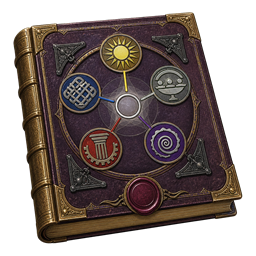
A sealed debate over whether the five gods are separate beings or five expressions of one mind, preserved together with the strongest objections to the claim.
The disputed proposition: Auralis, Vey, Thessa, Morcant Below, and Irielle the Unheard are not five separate gods. They are five expressions of one mind, divided because no mortal can endure contact with the whole.
Argument in favor: The five traditions divide life into separate concerns, but ordinary lives do not. A newborn receives the beginning of Auralis, a name witnessed before Vey, food shared under Thessa, protection made by the labor of Morcant, and a place in memory kept by Irielle. The rites stand beside one another because the needs they answer cannot be separated.
The same pattern appears at death. The last work is put in order. Debts and oaths are settled. Food is brought to the grieving. The dead person's name is preserved. The survivors begin again. Five shrines may serve one household before the mourning is complete.
Supporters of the proposition argue that the gods appear separate because mortals can understand only one part at a time. A person drowning needs rescue, not a complete account of creation. A miner behind a sealed door needs the machine to hold. A family at a deathbed needs food, witness, memory, and the strength to face the next morning. Each divine name may be the shape that allows a limited mind to approach a much larger one.
They point to similarities in old rites. Five traditions use spoken names, shared breath, repeated tones, and the presence of witnesses. Shrine healers who disagree about almost everything may still produce the same repair. Sailors sometimes invoke Auralis at departure and Morcant over the engine without believing they have changed the direction of their prayer.
From this, supporters propose five necessary faces. Auralis begins. Vey defines. Thessa joins. Morcant sustains. Irielle remembers. None is complete alone, but together they describe a life.
First objection: Similar rites do not prove a shared god. People carry customs between worlds, teach one another useful practices, and borrow language from the Loomsong heard everywhere in the Choir. Five builders can use the same tool without becoming one builder.
Second objection: The gods do not always agree. Mercy may release a debt that law would collect. Honest labor may preserve a machine that should be abandoned so its workers can live. Memory may refuse the clean beginning that survivors seek. These conflicts are not small differences in appearance. They produce different duties.
Supporters reply that one mind may hold conflicting needs. Their opponents answer that this makes the proposition impossible to disprove. Agreement becomes evidence of unity, and disagreement becomes evidence of complexity. A claim that explains every possible result may explain nothing.
Third objection: The five-face doctrine can be used to erase people. A large temple may declare a local rite incomplete and absorb it into its own teaching. A state devoted to one god may claim authority over every shrine by announcing that all worship serves the same source. A theory about divine unity can become a demand for human obedience.
Supporters answer that unity does not require one institution. Their opponents ask who will enforce that restraint once a ruler finds the doctrine useful.
Fourth objection: No surviving witness has encountered all five gods together and returned with proof that can be examined. Rare mercies, answered rites, visions, and impossible survivals are reported in every tradition. They establish that people experience something. They do not establish whether the source is one being, five beings, the Loomsong itself, unknown natural forces, or names placed over events that remain unexplained.
The proposition therefore remains what it was when this disputation began: possible, powerful, and unproved.
The seal on this copy bears no surviving order of suppression. It may have been closed because a temple feared blasphemy, because a ruler feared disorder, because the participants requested privacy, or because later readers kept treating an argument as a revelation. The reason is not recorded.
Read the proposition as a question. If the five gods are one mind, their differences may be the only forms in which mortals can meet it. If they are five, their cooperation does not diminish their distinction. If they are something else, neither side has named it yet.
No conclusion in this volume is a sixth voice. No sealed page proves that the writer heard more than anyone else.