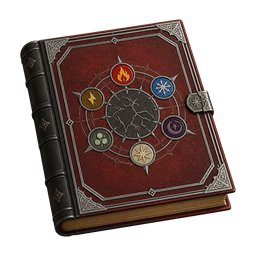
A range manual on fire, cold, lightning, poison, light, and dark spells, including their secondary effects, safe casting space, resistance, and the discipline of changing currents.
Destruction magic applies harmful force directly.
It burns, freezes, shocks, poisons, sears with light, and strikes through shaped darkness. The school is defined by the result it seeks, not by anger, cruelty, or the appearance of the spell.
A calm healer may learn Destruction to defend a clinic. A soldier may use it without understanding the injury produced. Intent matters to judgment. It does not change what the spell does to the target.
The six common currents
Fire converts mana into concentrated heat and flame. Ember Bolt carries that force to one target. Ember Nova releases it around the caster. Cinder Brand places a more concentrated burn upon one enemy and leaves the injury continuing after the first impact.
Fire spreads through ordinary materials after the spell ends. Cloth, oil, dry wood, gas, dust, insulation, stored medicine, and living growth may become part of the attack without the caster intending it. Know the room before creating the flame.
Cold removes or redirects heat. Frost Lance chills one target and can freeze an enemy already chilled. Frost Ring applies cold around the caster.
Cold changes more than flesh. Water freezes and expands. Metal contracts. Glass, ceramic, seals, and composite materials may crack. A frozen floor remains dangerous to allies after the target falls.
Lightning releases a fast electrical current. Storm Spark shocks the target and makes later harm more dangerous while the charge remains.
Electricity seeks paths through bodies, water, metal, conductive dust, machinery, wards, and nearby structures. A clear aim does not guarantee a simple route. Do not cast into an unknown power system merely because an enemy stands beside it.
Poison magic creates or carries a harmful substance or pattern that continues injuring the body. Venom Orb can place several poison wounds upon the same target. The next application does not make the earlier ones disappear.
Different bodies process poison differently. A creature immune to a natural venom may still react to a magical poison built on another pattern. A dead poisoned creature may remain unsafe to butcher, eat, or touch.
Light can be condensed until it burns. Dawn Ray directs that force at one target. This is not ordinary daylight made brighter. It is shaped harmful radiance.
Reflective surfaces, lenses, mirrors, polished armor, and light-sensitive machinery may change how a light-working behaves. Never assume that a beam ends where it first becomes difficult to see.
Dark can be shaped into a harmful absence or pressure. Night Shard carries that pattern as a direct strike.
Dark damage is not the same as low light. Extinguishing a lamp does not cast it. Lighting a room does not automatically remove it. Treat the working itself rather than arguing with its name.
A spell and its aftermath
The first impact is only one part of many Destruction spells.
Burning continues fire injury. Chilled movement becomes slower, and a second cold working may freeze the target. Shock makes later damage more severe. Poison builds through repeated application.
Choose the spell for both effects. A target that must be stopped immediately may justify cold. A dangerous enemy about to receive several attacks may be vulnerable after lightning. Poison rewards time and repeated pressure. Fire can continue doing harm while also making the environment unsafe.
Light and dark provide direct currents when another element is resisted or the terrain makes it dangerous.
Do not apply an ailment without knowing how it will be removed from an ally struck by mistake.
Resistance
Every current meets different defenses. Thick hide may stop a blade and fail against heat. A fire-adapted creature may ignore flame and remain vulnerable to cold. A machine sealed against water may carry lightning efficiently through its own frame.
Observe the result. A spell that strikes cleanly and produces little effect is giving useful information. Do not repeat it until the mana is gone merely because it is the spell you know best.
Destruction schools teach Cross Current: follow one damage type with another when the first meets strong resistance. Advanced practitioners learn to shape the change so the second current penetrates part of the defense more effectively.
Cross Current is not random casting. The caster must remember what was used, read the target's response, and choose a different force that the surroundings can safely receive.
Elemental Fracture can weaken several nonphysical resistances before the next Destruction spells arrive. That working belongs to Alteration because it changes the target's defenses rather than delivering the main injury itself.
Range discipline
Establish a target, a clear path, and a safe area beyond it. Account for companions, moving civilians, animals, reflective surfaces, open water, pressure walls, fuel, medical stores, machinery, and active wards.
A single-target bolt can miss. A circle centered upon the caster can strike every enemy nearby and still create dangerous terrain for friends. An effect that continues after impact may reach people who enter later.
Call the spell when fighting beside others. “Fire,” “ring,” or “shock” is often enough if the party agreed upon the calls beforehand. A warning invented during the cast arrives too late.
Practice stopping the pattern before release. Mana already shaped may need to be grounded, dispersed, or allowed to fade through a safe focus. Do not throw an unwanted spell at the floor unless the floor was chosen as a safe target.
Mana and control
More mana can increase a working's power only while the caster still controls its shape. Beyond that point, extra force enlarges the mistake.
Watch for trembling, narrowed attention, delayed speech, loss of aim, repeated phrases, heat or cold in the casting hand, and the belief that one final spell will solve the exhaustion caused by the previous one.
Stop before control fails. Change to a weapon, move behind cover, or let another caster take the line.
Destruction is often the first school judged by how much damage it can produce. A trained practitioner is judged by something harder: the intended target is harmed, the allies are not, the room remains survivable, and enough mana remains for whatever the enemy does next.