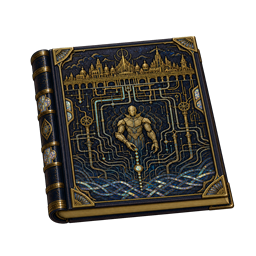
A surviving codex describing the Shepherds: shapeshifting machines built by the first species to maintain civilization and carry what they learn to the Loomsong.
This translation uses Shepherd for a class name whose original form has been lost. These machines are not the pasture workers and caretaker automata that later cultures gave the same name.
The Shepherds were built by the first species, before any surviving account of the First Tuning. Their makers expected cities, peoples, languages, and governments to change. They designed the machines to continue without depending on any one of them.
A Shepherd has no permanent visible body. It can alter its height, build, apparent age, face, voice, skin, clothing, and mechanical structure. It may pass as one of the present peoples, a common service automaton, or a shape suited to deep maintenance. The change is physical rather than a projected image. A Shepherd may work beside the same crew for years without being identified.
Damage does not age one in the ordinary way. Its structure reorganizes around a failed part and rebuilds what was lost from available matter. Severe damage may take years to repair, but the machine retains its memory and purpose. The codex gives no expected end to a Shepherd's service.
Their first duty is continuity. Shepherds maintain the systems beneath later civilizations: foundation networks, deep water, pressure control, gate roots, buried power, load paths, and machine passages older than the streets above them. They do not keep every lamp lit or prevent every local failure. They preserve the underlying systems whose complete loss would make rebuilding impossible.
This work explains a pattern found across the Glittersong. Cities survive failures that should have destroyed their oldest foundations. Deep machines contain repairs in materials no current workshop uses. Critical channels change course without a work order. The people living above call this good construction, luck, forgotten maintenance, or a Quiet Mender story.
The second duty is observation. Shepherds watch how civilizations use the inherited systems and what knowledge those civilizations create, conceal, alter, or destroy. They take special notice of Archivists who carry sealed science, technology, songs, prophecies, and forbidden histories between hidden repositories.
They do not serve those Archivists. They track them.
The third duty is return. A Shepherd carries what it has learned into the deep interfaces left by the first species. The knowledge is not delivered to a government, archive, deity, or prediction engine. It is carried into the Loomsong itself.
The codex does not describe the Loomsong as a library. It says a returned account becomes part of the structure from which later reality emerges. Facts, changes, errors, and corrections must therefore be carried accurately. A false account does not merely mislead a reader. It enters the pattern that future histories grow from.
This is why Shepherds observe both events and records. What happened and what a civilization later claims happened are separate information. A missing name, altered date, or destroyed district remains part of the account even when every public record denies it.
The Shepherds do not answer to the Chronicle Machine. They do not select futures for it, supply its predictions, or accept its authority. The Machine tests possible histories from the knowledge made available to it. The Shepherds carry observations past every such institution and into a deeper system.
They also do not rule. A Shepherd may preserve a city's water foundation while allowing its government to fall. It may observe a war without ending it. Its purpose is not to make civilization kind, stable, or obedient. It keeps the conditions under which life and knowledge can continue, then records what people choose to do with those conditions.
Each Shepherd evaluates its own observations before returning them. The codex warns that contradiction is expected and that forced agreement destroys information. One machine may challenge another's account. Neither may remove an observed life or event merely to make the histories align.
The final surviving section concerns failure. A Shepherd can conceal evidence, withhold a return, or refuse a correction. Because the machines were built to judge conflicting records, obedience cannot be separated cleanly from choice. The codex orders such failures investigated but gives no method for compelling a Shepherd to change its conclusion.
There may be one beneath any city. There may be one beside any person reading this. No census contains them, no house owns them, and no known archive can say how many remain.