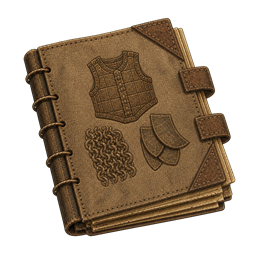
A wayfarer's guide to leather, brigandine, layered harnesses, balanced protection, equipment access, long-road repairs, and changing weapons without fighting the armor.
Medium armor is built for people who expect both danger and a long road before it.
It uses leather, reinforced cloth, brigandine, mail sections, overlapping scales, small plates, rigid inserts, tool harnesses, and other layered constructions. It protects more directly than light armor without surrounding the wearer in the weight and structure of a heavy shell.
The result is not light armor with extra pieces or heavy armor with missing plates. Medium armor has its own design: protection carried where it matters while joints, tools, weapons, and travel remain practical.
The full kit
A complete medium kit may include cap or cowl, shoulderguards, protective shirt, jerkin or harness, bracers, gloves, utility belt, leggings, shin guards, and boots.
The layers must share the load. Shoulder pieces should not hang entirely from the neck. A chest harness should transfer weight through the torso and belt without restricting breath. Bracers and gloves must meet without leaving a hard ridge across the wrist. Leg protection should move with hip, knee, and ankle rather than sliding down onto the foot.
Medium armor often carries more equipment than the other classes. Pouches, tool loops, climbing fittings, medicine, spare string, ammunition, repair material, and a second weapon set may all be attached.
Every attachment changes balance. Place heavy objects close to the body. Keep them away from joints. Do not cover fasteners that must be opened during treatment. Secure anything that swings, rattles, or catches brush.
A utility belt is not useful when every pouch occupies the same reachable hand.
Layered Fit
The first medium-armor discipline is called Layered Fit.
Start with the layer against the body. It controls sweat, rubbing, insulation, and the pressure of harder pieces above it. The protective layer then spreads force. The outer layer handles weather, abrasion, and attachments.
Each must move without pulling the others out of place.
Too loose, and the armor shifts before receiving the blow. Too tight, and it limits breathing, blood flow, reach, and the body's ability to cool. A harness adjusted while standing may bind when crouched beneath a pack. Fit it under the actual load.
Body shape matters. Tail openings, wings, multiple arms, carapace edges, feathers, fur, breathing structures, and automaton joints require deliberate patterns. Medium armor is well suited to modular adaptation, but a collection of improvised gaps is not the same as a fitted kit.
Balanced Stride
Medium armor permits steady movement when its weight is distributed correctly. The wearer should be able to walk for hours, climb, kneel, rise, and fight without the same strap becoming more painful at every step.
Balanced Stride is trained with full road equipment. Walk until the harness settles. Mark every point that rubs, shifts, or strikes the body. Adjust one part at a time and repeat the route. A short fitting-room test cannot reproduce heat, fatigue, rain, stairs, or a pack emptied unevenly through the day.
Medium armor does not move as freely as light armor. It should move freely enough that the wearer still has choices.
The kit works well for scouts expecting direct contact, hunters of dangerous game, expedition workers, rescue crews, caravan guards, and fighters who alternate between different weapons or tasks.
Swap in Stride
Experienced wearers arrange weapons so one set can be secured and another drawn without stopping in an exposed place. This is called Swap in Stride.
The technique depends upon the harness. Sheaths, slings, hooks, quivers, focus loops, and shield positions must not cross one another. The weapon being put away needs a secure place even when the wearer cannot look down.
Practice first while standing, then walking, then moving through turns and uneven ground. Use unloaded ranged weapons and covered edges until the sequence is reliable.
Changing weapons while moving is useful only if the new weapon is ready when the change ends. A bow tangled in the pack, a shield trapped under a strap, or a focus dropped behind the party is not a successful swap.
Receiving a hit
Medium armor combines flexible layers with harder local protection. Leather and cloth spread abrasion and cutting. Brigandine, scales, mail, or inserts resist deeper entry and distribute force across a broader area.
Gaps remain around joints and movement points. A hard layer can also transfer impact into the body beneath it. Inspect bruising, joint damage, broken ribs, punctures, and internal injury even when the outer piece survives.
Replace cracked inserts and plates. Repair torn stitching across the full load path, not only the visible opening. A plate sewn back through weakened material will tear free sooner during the next impact.
Armor damaged by acid, poison, heat, extreme cold, resonant discharge, or unknown contamination may not be safe to handle barehanded. The threat can remain after the fight.
Working sets across the expeditions
Greenveil Thornrunner armor balances brush movement with reinforced protection. Glassmoon Shardwalker harnesses serve low-gravity habitats and mineral routes. Gogi-One's Servicewright gear supports maintenance among ark ruins and caretaker machines. Deepforge Railwright equipment distributes tools and load under heavy gravity.
The Sable Writ Isles use Writkeeper witness harnesses. Asterhome has Homestead Mender utility armor. Mirror Belt surveyors wear Parallax instrument harnesses. Tide Court Sanctuary Tenders use rescue harnesses around ferries, roots, and water.
These names show why medium armor is common among working specialists. A harness can carry local instruments and still protect the wearer. The arrangement must not turn every fall into a landing upon sharp tools.
Roadmender care
Medium armor contains several materials that require different care.
Dry cloth and padding. Clean and condition leather without leaving it slick. Remove dirt from mail and plate joins. Protect metal from corrosion. Check resin, stitching, rivets, buckles, laces, and load-bearing straps. Empty every pouch before washing or heating the armor.
Carry material for small road repairs: strong thread, needles suited to the layers, spare cord, a few correct fasteners, leather patches, and whatever treatment the local materials require.
Roadmender practice also cares for the wearer. Shift the load before numbness begins. Treat rubbing early. Air the underlayer during safe stops. Drink before the harness makes thirst easy to ignore. Repairing the body and the armor during travel prevents both from failing together.
Choosing medium armor
Choose medium armor when the journey requires protection, mobility, tools, varied weapons, and long use in the same kit.
It will not move as easily as light armor or absorb as much direct force as heavy armor. Its strength is that neither compromise controls the whole design.
Balanced equipment does not mean effortless equipment. Fit the layers, arrange the load, and practice every task before the road makes the choice urgent.